


Undertone
Consuming Other People’s Trauma as Background Noise.
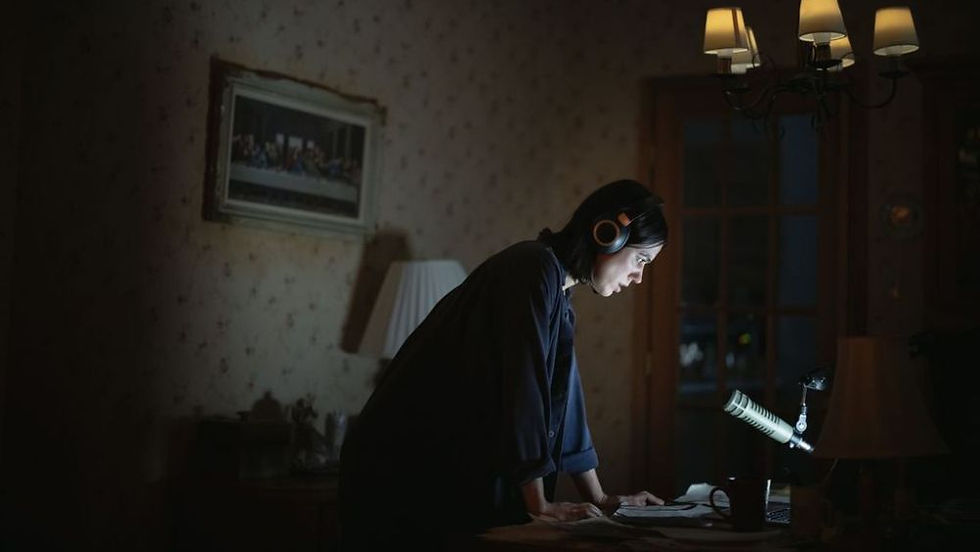
There is something about A24, a certain sense of fatigue. Once an indie production company synonymous with modern arthouse elevated horror, it now often feels like a rabbit hole for ambitious ideas that never fully land.
That’s exactly where “Undertone,” the debut feature from director Ian Tuason, left me.
Maybe I should start with a disclaimer: I’m not the right audience for this kind of film—and that matters. “Undertone” plays within a very specific mix of digital obsessive trends—true-crime podcasts, post-lockdown vibes, and the cringe idea of resurfacing demonic urban legends—without ever transcending them.
If creepypasta-fueled supernatural horror is haunting your late-night guilty pleasures, this film is definitely for you. But for someone like me, who gets haunted by the most unsettling and disturbing stories—the lingering ones, the ones I can relate to, feel, or think about for months or years—this is an easy skip, or at least something to approach with very low expectations.

“Undertone” is an experiment in atmosphere. Evy (Nina Kiri, carrying the weight of the film almost entirely on her own) spends the whole runtime inside her house, caring for her dying mother, who lies in a catatonic state.
Her only escape is the podcast Undertone, which she runs with Justin (Adam DiMarco), whose ambiguous role becomes one of the film’s few points of intrigue—or at least the only element that gave me some genuinely chilling doubts. But no spoilers here, and intrigue alone isn’t enough.
When Justin proposes an episode about ten disturbing audio tapes sent to him by a mysterious follower, Evy feels an immediate pull—something she needs to dig into in her own way (which, honestly, most of us would do).

What follows is an obsessive search through unreliable sources and dark references, especially tied to the songs in the tapes, sung by a couple in their sleep.
A film built around one of our everyday companions, like a podcast, could have offered a sharper commentary on our obsession with consuming trauma as entertainment…like voices from a TV left on in the background…never disturbing enough to make you turn it off, or truly listen.
Instead, it never evolves beyond a narrative device—something that only exists when Evy’s headphones are on.
What remains is a film where very little happens (intentionally so) but without the psychological or emotional depth needed to make that stillness truly claustrophobic and unsettling.
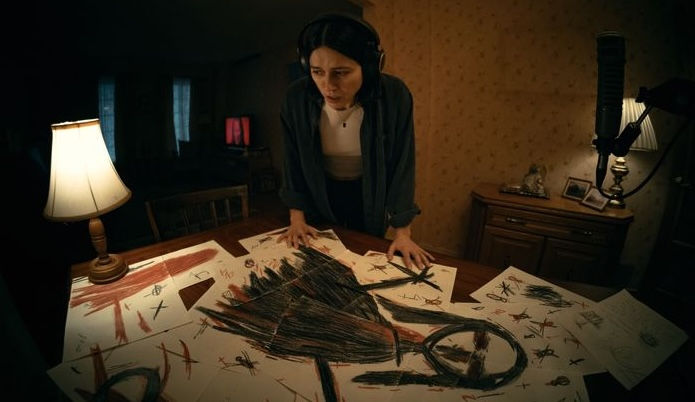
Despite the promise of its premise, the film leans heavily on its technical strengths. The sound design does most of the work, crafting an eerie, persistent tension, while the cinematography makes effective use of its confined setting—the house and its rooms.
Tuason’s direction shows a clear understanding of space and restraint—a filmmaker with potential and ideas, though still in an in utero stage.
Unfortunately, even well-developed details can turn against you when the script feels like it gives in to its own ghosts.
My experience with “Undertone” (and my expectations were quite high) was defined more by boredom than dread. I kept waiting for the film to either say something meaningful or push its premise into more disturbing territory, but it never quite commits—becoming, at times, predictable.

There is certainly an audience for this. Fans of ambient, sensory-driven horror—films like “Skinamarink,” “Berberian Sound Studio,” or “Pontypool”—may find “Undertone” immersive, even emotionally evocative.
But for me, it felt more like a melody of old, familiar ideas sold as something intriguing—restrained in its pursuit of innovation, and ultimately hollow.


Comments