


28 Years Later:
The Bone Temple
Infection as Belief in Societal Collapse — Survival as System of Cruelty.

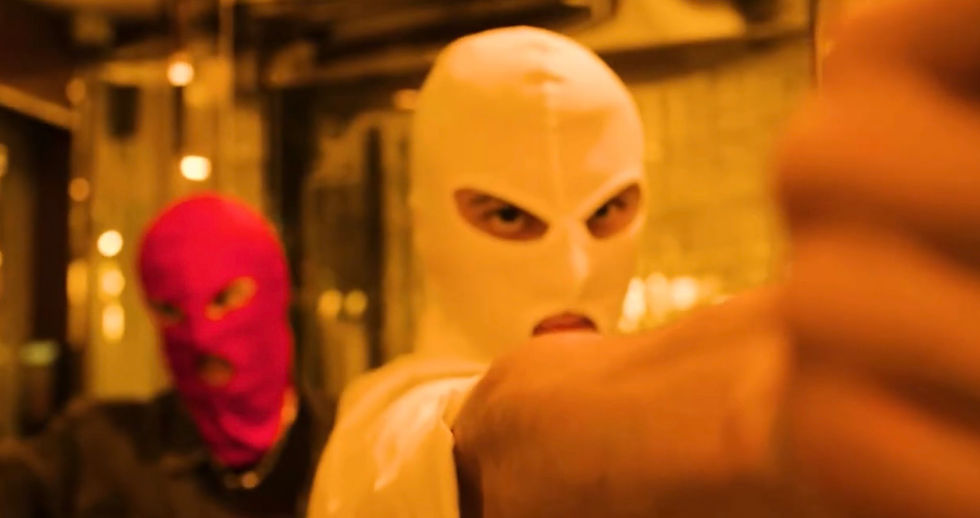
As the first (or third) instalment, “28 Years Later” opened in violence and blood, “28 Years Later: The Bone Temple” begins exactly where the film left us: Jimmies doing what Jimmies do best, culminating in a cruel, blood-soaked pool massacre that introduces us fully to the cult of a psychopath–megalomaniac, a Teletubbies-on-acid version of Jimmy Savile.
The scene is the perfect opener to a film that deliberately allows violence to linger not as mere display, but as aftermath—cruelty stretched long enough to become grotesquely uncomfortable.
It was never particularly difficult to grasp what his cult was about, but this new chapter makes it painfully explicit, positioning Jimmy Crystal (Jack O’Connell) and his gang at the centre of the narrative, alongside a magnetic Dr. Kelson (Ralph Fiennes) and Spike (Alfie Williams).

I won’t lie—I was hoping the film might take a different direction, one that explored aspects of character development I felt were left behind in “28 Years Later,” overall Spike’s mother, Isla (Jodie Comer), a character I still want to believe has something to say, even if apparently gone.
Instead, “The Bone Temple” shifts its focus towards what humanity has become, maintaining the tonal bleakness of its predecessor while reframing it through a new and unsettling perspective.

If Danny Boyle’s “28 Years Later” felt like a direct statement on post-Brexit/post-pandemic Britain, this chapter leans into a trend contemporary zombie cinema has increasingly embraced: the infected are no longer simply monsters clawing their way back from the dead, but symptoms of a society already lobotomised by its own fractures.
Directed by Nia DaCosta and once again written by Alex Garland—whose nihilistic and cynical worldview is unmistakably present—the film follows characters that feel deliberately symbolic.

Spike embodies stolen innocence: a reminder of a pre-social-media childhood erased by oppressive systems that forced children to become adults far too soon. In a digital era drowning in information and misinformation alike, belief, wonder and lightness are casualties, replaced by confusion and accelerated disillusionment.
Dr. Kelson represents memory and knowledge—a man who lived a “real life” before the collapse. Through his fusion of medical understanding and historical awareness, he is able to see through the rot of the present world, though his insight comes with a tormented clarity that knows exactly what must be done, and at what cost.
Alpha Samson (Chi Lewis-Parry) is human decay in its purest form: a manipulated, eroded mind no longer certain of its own identity, yet still clinging to fragments of humanity buried somewhere beneath the rage.
The relationship between Kelson and Samson is, without question, the film’s emotional core—and the key to understanding this chapter. Samson’s mental and physical evolution is devastating to witness, and even here I can’t say too much—you’ll understand when you see it.

Then there’s Jimmy, the cult leader himself: a man shattered by trauma and PTSD, surrounded by disturbingly infantilised followers—his Fingers. In his fractured psyche, a father figure, once a Christian priest, mutates into something demonic, convincing Jimmy that he is the son of hell itself.
This toxic combination explains both who he recruits and why: fragile minds, simmering anger, personalities already on the brink. Together, they spiral into chaos perfectly aligned with his vision.
One particular sequence—the invasion of a quiet farming community—exposes the cracks within the group and the moment Jimmy’s belief system begins to fracture.

“28 Years Later: The Bone Temple” captures a collective sense of being lost: a society increasingly defined by division, where groups seek dominance through a warped sense of theological or moral superiority rather than any desire for unity.
Music plays a crucial role throughout, from Duran Duran to Iron Maiden, culminating in an unforgettable scene I won’t spoil—especially since too many already have. What I can say is that, sitting in my cinema seat, I was torn between laughing, wanting to jump up, sing, and head-banging.
The ending, however, is where my enthusiasm faltered slightly, and left me oddly deflated, functioning as a moment of calm paused before belief becomes total chaos.
My disappointment stems from excitement rather than rejection. A much-hyped comeback failed to fully resonate, especially as I’d been hoping for a different re-emergence…one with more impact, tension, and narrative payoff.

At heart, “The Bone Temple” is a solid film, while loaded with too many—perhaps—ideas, unmistakably channels the fractured, anxious moment we’re living through.
If “28 Years Later” divided audiences, “28 Years Later: The Bone Temple” will divide fans even more. A film where every choice, every word, demands to be examined more closely.
It’s one of the rare mainstream horror films that understands exactly what needs to be done—and does it fiercely. Just prepare yourself for the most grotesque apocalypse truth.


Comments