


Karmadonna
Vengeance wears many faces…Gods included. Morality meets Mayhem in a Grotesque made Philosophical.

If in 2026 we still need to discuss the words of Gods, it means that not much has been done to turn spirituality into a call for self-awareness. Instead, it still plays a major role in politics and in how we choose to define what is good and what is not.
The controversial screenwriter Aleksandar Radivojević, who co-wrote “A Serbian Film,” now directing his debut feature-length “Karmadonna.”
There is no denying his ability to craft messy and chaotic narratives as a form of resistance against oppressive systems.

“Karmadonna” is an action-thriller infused with horror and gore, laced with bleak humour and that unmistakable cold Slavic coldness—often misunderstood, yet fearless in confronting social and cultural themes.
The film opens with Jelena (Jelena Djokic), seated on a park bench, when she receives a call from an unknown number. On the other side is God—Siddhartha, Buddha…the content creator—ordering her to kill in the name of the child she carries.
This is just the beginning of a vengeance-driven narrative that unfolds as a slow-burning and initially disorienting experience. In its first half, you may find yourself wondering where the horror and brutality are hiding.
Rather than pursuing pure provocation, the film carries a distinctive political and social charge. It offers a contemporary perspective from Serbia and the wider post-Yugoslav landscape, while extending its reflections to Western societies and our moral disarray.

“Karmadonna” functions as a microcosm, exploring a wide spectrum of provocative themes through a dystopian-surreal narrative skeleton.
Jelena, the main character, is a pregnant woman resembling a modern Virgin Mary. Her divine calling becomes a metaphor for the immense social pressure imposed upon women. She gradually transforms into a weapon of self-awareness and defiance, reclaiming her force within a system designed to suppress it.
The film’s political critique shifts its focus from institutional power to a subtler and more pervasive corruption: social media. Influencers, stripped of substance or purpose, disseminate ignorance and misinformation, fuelling the destructive machinery of public shaming and cancel culture.
This results in a satire of absurdity, where moral disputes are dissected through philosophical, graphic, and grotesque imagery.
The equilibrium between dialogue, narrative, and violence is largely effective, despite the deliberately slow pacing of the first half. When the film finally reaches its climax, it does so with visceral intensity.

If any criticism is warranted, it concerns the running time. At nearly two hours, the film would benefit from a slightly tighter pace, yet it never becomes truly tedious.
Viewers expecting extreme gore or a new version of “A Serbian Film” may feel underwhelmed. However, those willing to surrender to the plot will discover an absorbing experience that transcends mere shock value, offering substantial material for reflection.
“Karmadonna” becomes a journey in which moral inquiry fuses with religious symbolism, generating a striking vision of philosophical violence. Jelena descends into a labyrinth of brutality, navigating questions of ethics and individual survival within an oppressive, spiritually infused system.
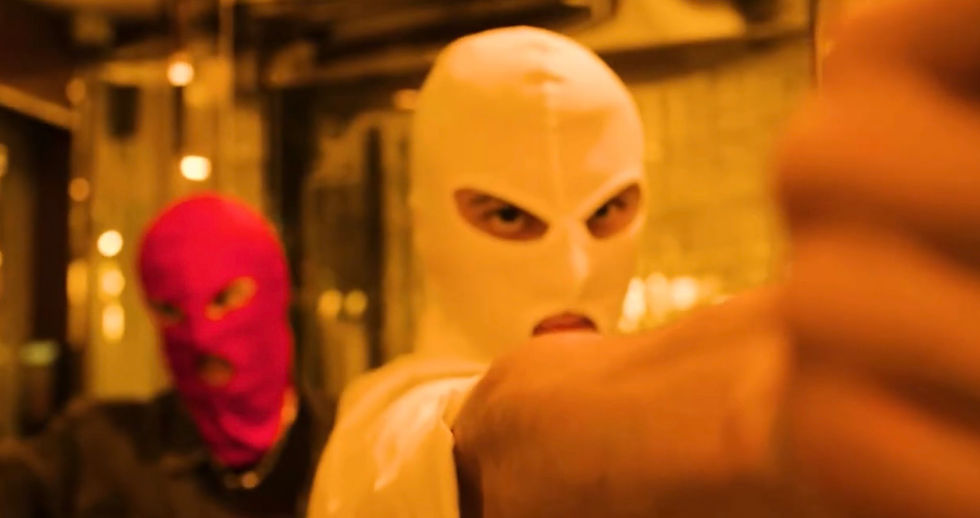
As the film approaches its final act, chaos erupts and her influence spreads. It evokes Lamberto Bava’s Italian cult classic “Demoni.” A vision of possessed bodies and collective hysteria, where a quasi-divine squad enforces vengeance according to its own distorted moral code.
Cinematographer Aleksandar Jakonic enhances this descent through saturated, hallucinatory compositions that amplify the film’s emotional and ideological weight.

This is not a film designed to please everyone. For those prepared to plunge into its rabbit hole of madness, “Karmadonna” offers a rebellious force that challenges imposed rules—both in the real world and in the digital ecosystem we have created.
It exposes the latent evil within and around us, transforming it into an unstoppable antagonist: a karmic reckoning that refuses to leave your mind. Be ready to fall, and to stand up again—because we are all living inside a bubble nightmare.


Comments