


White Snail
How does a Modelling Dream end in a Morgue?

“White Snail,” directed by Elsa Kremser and Levin Peter, follows Masha (Marya Imbro), a Belarusian model chasing a career in China who becomes drawn to Misha (Mikhail Senkov), an aspiring painter working at the morgue.
Their unlikely connection unsettles her sense of beauty, mortality, and the body itself. What begins as fascination turns into a fragile love story between two lost souls acknowledging that isolation doesn’t have to mean invisibility.

At first glance, the film leans on a familiar cliché—the Eastern European girl, beautiful and cold, longing to escape an oppressive, futureless cultural landscape.
“White Snail” subverts that idea, exposing the exhaustion beneath the dream—the way ambition curdles into despair when freedom becomes a myth.
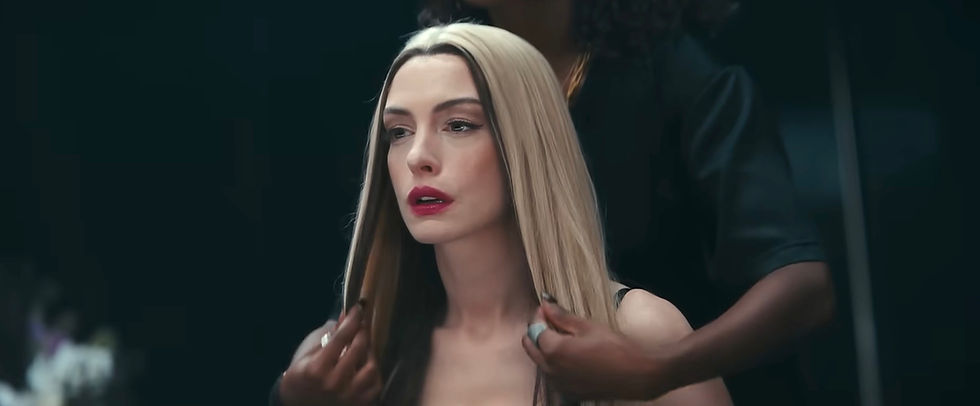
Mikhail Khursevich’s cinematography frames this unease in luminous contrasts: red, green, and neon night hues bleed into sterile daylight, creating a world that feels both clinical and melancholy.

Even Masha’s quiet gestures—like the suffocating plastic bag scene—pulse with the weight of existence. Much of the film unfolds in nocturnal stillness, the deep blues of night punctuated by fragile pools of streetlight.
Misha’s art mirrors their shared unrest. His paintings are dark, raw, confessional—life is scary, he admits—while his tattooed body becomes its own living canvas of memory.
The camera’s lingering stillness turns each frame into a painting, blurring the line between beauty and decay.

Dialogue drifts between the anatomical and the existential, especially when Misha describes his autopsies—unflinching, almost tender in detail. Through him, the film dissects humanity’s obsession with perfection, even in death.
Masha, meanwhile, moves like a figure out of religion—a spectral embodiment of superstition and salvation. The massage fortune-teller she visits is filmed like an exorcism chamber, purging what’s impure.

Misha stands as her opposite: the doomed artist, misunderstood and quietly collapsing inward.
Loneliness seeps through every scene—that kind of loneliness you feel even in a crowded room. “White Snail” captures it perfectly. It’s about wanting to escape yourself but fearing you’ll never find your way back.
As the story drifts beyond the city, the directors explore the delicate space between fragility and surrender.

The chemistry between newcomers Marya Imbro and Mikhail Senkov is striking, tender, uncertain, and real. The directors’ choice to keep them apart until filming gives their first interactions a raw, hesitant authenticity that suits perfectly the alienation the film aims to show.
At times, “White Snail” risks drifting too deep into its own stillness, its meditative pace testing the viewer’s patience—yet that very slowness becomes part of its spell.

“White Snail” is a hypnotic meditation on loneliness, beauty, and the body as both a vessel and a prison.
With stunning visual precision and emotional restraint, Kremser and Peter craft a haunting love story that lingers like a bruise—cold, poetic, and quietly devastating.


Comments