


Eddington
When Freedom Becomes a Weapon, and a Film That Demands a Post-Credits Therapy Session: Unfiltered Chaos Will Shatter Your Perception.
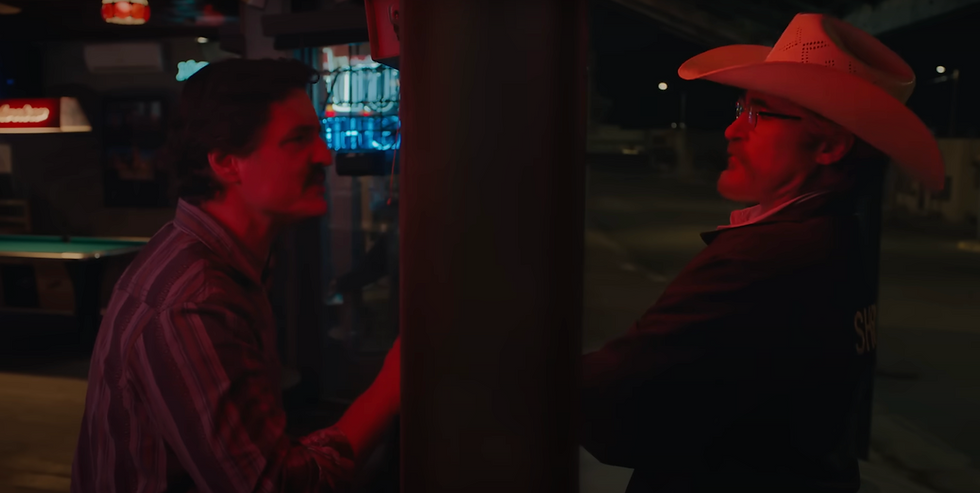
Describing “Eddington” as a neo-western might be the most fitting way to summarise Ari Aster’s 2025 dark comedy-drama—though even that hardly scratches the surface.
That said, I felt I needed a full ten minutes of silence after the credits rolled, just to process what I’d witnessed.

It’s an Ari Aster film, after all, so if you’re familiar with his work, you’ll know to expect a whirlwind of emotional and thematic disarray. But Eddington isn’t just messy—it’s exquisite, unfiltered chaos.
If you’ve seen the trailer, don’t be misled. It barely teases the disorienting spiral that unfolds. The story kicks off in May 2020, amidst the height of the COVID-19 pandemic.
What begins as a snapshot of public hysteria—conspiracy theories, anti-vaxxers, and the fear-soaked atmosphere—rapidly morphs into something darker and more disturbingly real.

We’ve spent the past five years collectively unmoored—adrift in chaos, where appearances deceive and identities dissolve. It sometimes feels like a failed social mutation—one born from freedom pushed to its breaking point—an evolutionary misstep we fought to achieve, only to have it turn against us.
Let’s be clear: freedom is a vital human right. But when it becomes indistinguishable from anarchic self-destruction, something has clearly gone awry.
At its core, Eddington follows a standoff between small-town sheriff Joe Cross (Joaquin Phoenix) and Mayor Ted Garcia (Pedro Pascal), set in the fictional town of Eddington, New Mexico.
Their clash is both personal and political—complicated by Garcia’s fraught history with Cross’s wife, Louise (Emma Stone), and mother-in-law, Dawn (Deirdre O’Connell).

Aster revisits his obsession with overbearing maternal figures, folding that tension seamlessly into the wider conflict as the two men find themselves on opposing sides of the mask debate.
The film is deliberately provocative, often hollow by design, and it’s a difficult piece to review. You’ll laugh, you’ll wince, you’ll question what you’re watching—and you certainly won’t find it comforting.
Aster touches on themes like racial division, though arguably without much new to say. The Black Lives Matter movement is clearly present in the film’s DNA, but its representation feels muddled—more gestured at than fully explored.
Before it can fully engage with those ideas, the film veers off into another subplot filled with irrationality, violence, and distraction—perhaps intentionally mirroring how public attention shifted in real time.
What he does capture is the paranoia, anxiety, and social fragmentation that exploded when lockdowns began and the world collectively panicked. He blends it into a fever dream of confusion and satire, offering no answers—just raw sensation.

Much of the chaos is filtered through the lens of social media, which becomes the film’s true stage. It’s where the news is curated, where lies take root, and where misinformation thrives.
To emphasize this aspect, the film extensively employs the screenlife technique, blending traditional storytelling with found-footage and mockumentary styles. And let me tell you, it works remarkably well, enhancing the overall sense of realism.
Paranoia spreads like wildfire, jokes mutate into threats, and morality dissolves into a game of psychological warfare, disinformation, and mass manipulation.
Unsurprisingly, Eddington has sharply divided critics—and will likely do the same with audiences. Expect fiery debates. Some will praise its fearless ambition; others will dismiss it as bloated, incoherent, or pretentious. And honestly, that may be exactly what Aster intended.
As always, his visual storytelling is exceptional. Darius Khondji’s cinematography (Uncut Gems, The Immigrant) balances the film’s absurdity and dread with a sharp, immersive eye. Lucian Johnston’s editing keeps the pacing surprisingly taut, especially for a film that thrives on disorientation.

Aster’s visual language for violence remains as potent as ever. When revenge time comes, it hits with darkly funny moments—especially during ‘The Antifa Massacre,’ which delivers shocking laughs and gory satisfaction in true Ari Aster fashion.
But after all that—did I like it?
There’s brilliance in Eddington—but perhaps brilliance trapped in a maze of its own ambition, leaving something essential just out of reach.
The ride remains undeniably compelling. Ari Aster remains one of the most fascinating directors working today.
But, as with Beau Is Afraid, he tests the limits of narrative and patience. There’s brilliance in Eddington, but there’s also a sense of something missing—maybe too much of everything, all at once.

This isn’t a comfort film to watch. It won’t leave you with a clear head. In fact, you’ll probably leave the cinema clutching your skull, trying to piece together the fragments.
My advice? Watch it with a good friend—or a few—who appreciate psychologically demanding cinema.
Because once the screen fades to black, the real film begins—in your head, and in the conversations that follow.
WATCHED AT:



Comments